


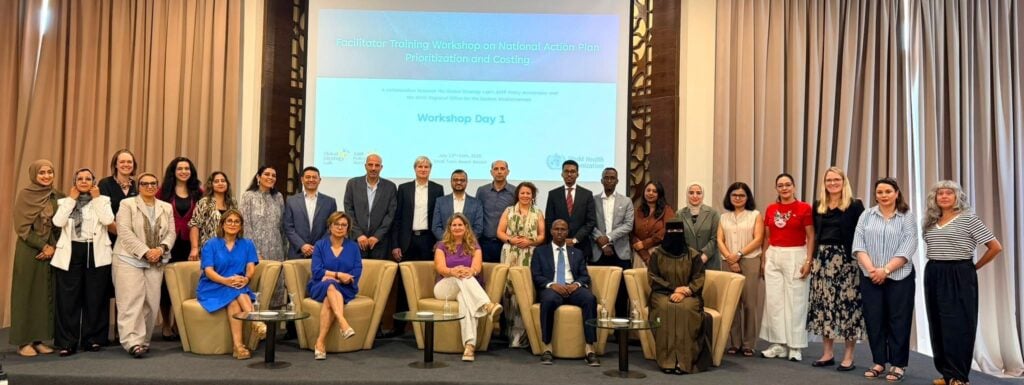
From July 13 to 16, the Global Strategy Lab’s AMR Policy Accelerator and the World Health Organization delivered training to representatives from nine countries across the Eastern Mediterranean region on how to implement two practical tools to support effective National Action Plan (NAP) implementation: the Smart Choice Process (SCP) and the WHO AMR Costing and Budgeting Tool. Regional and global partners also partook in the sessions. This training was hosted by WHO Country Office for Tunisia under the AMR Multi Partner Trust Fund (MPTF) grant.
The workshop aimed to strengthen regional and country capacity in the prioritization and costing of AMR interventions, corresponding to steps two and three of the six-step approach outlined in the WHO Implementation Handbook for Sustainable National Action Plan Implementation for Antimicrobial Resistance. It also marked the first time the SCP was delivered as a dedicated facilitator training, part of a broader effort to translate the updated Global Action Plan on AMR and the Global Action Plan on infection prevention and control (IPC) into prioritized, costed, and financeable national plans.
This work was made possible through a strong collaboration with the WHO Regional Office for the Eastern Mediterranean (EMRO), Dr. Shaffi Fazaludeen Koya and Dr. Iman Heweidy, and WHO Headquarters, Dr. Sarah Paulin-Deschenaux, who brought partners together to advance practical approaches to AMR action planning in the region. Dr. Heweidy attended the SCP training in Nigeria last August 2025, where she experienced the process firsthand and helped strengthen the foundation for this regional facilitator training. We are deeply grateful for their committed partnership and for their leadership in launching this training in the Eastern Mediterranean region.
A country-led approach to prioritization
Developed by the AMR Policy Accelerator, the Smart Choice Process is a country-led, multisectoral approach that supports governments in the systematic and transparent prioritization of their NAP interventions for AMR. The process brings together representatives across human, animal, plant, and environmental health sectors to assess potential interventions, build consensus, and identify high-impact, feasible, and equity-driven priorities for action. To date, the Accelerator has worked with nine countries to implement the SCP in a country-specific context.
The workshop in Tunis also marked the launch of the SCP Prioritization Scoring e-tool, designed to digitally guide country teams through key steps of the SCP prioritization process independently.
GSL’s AMR Policy Accelerator team, Julia Bishop, Dr. Kadia Petricca, and Heba Qazilbash, led the SCP training, guiding participants through the foundations of the process, how to use the prioritization scoring tool, and the development of stakeholder mapping.
“This workshop marks the culmination of a year of close collaboration with our partners at WHO EMRO to strengthen country teams’ capacity to efficiently prioritize and cost their national action plans,” said Dr. Kadia Petricca, Senior Policy Lead, Global Strategy Lab.
In pairing the SCP alongside the WHO Costing tool training, participants were able to gain skills to both prioritize and cost AMR interventions in their own national contexts. Alongside the GSL team, WHO colleagues Dr. Sarah Paulin-Deschenaux and Paul Verboom co-facilitated the costing sessions, with Yidnekachew Mazengiya sharing lessons from the WHO Africa Region’s experience and Erica Westwood of the International Centre for Antimicrobial Resistance Solutions (ICARS) sharing insights on implementation best practices.
“This is an important step in building regional capacity to translate the updated Global Action Plan on AMR and the Global Action Plan on IPC into national, context-specific, prioritized and costed plans,” said Dr. Sarah Paulin-Deschenaux, Technical Officer, AMR, WHO Department of AMR Surveillance, Prevention and Control.
The Accelerator team looks forward to continuing to support country teams as they apply the SCP Prioritization e-tool in their own national contexts, and to ongoing collaboration with partners committed to sustainable, impactful AMR implementation.
Learn more about the Smart Choice Process.
 Previous